
Service Dog FAQs
with Sandpoint Doodles
Welcome to our Service Dog FAQ! Below, you’ll find answers to frequently asked questions about both service dogs in general and Sandpoint Doodles training program. We cover everything from “do I qualify for a service dog?”, “where can I buy a service dog?” to “how much do service dogs cost?”. If you’d like to discuss adding a dog to your family or program, please reach out by phone—we look forward to connecting with you!
Service Dog Buyer’s guide
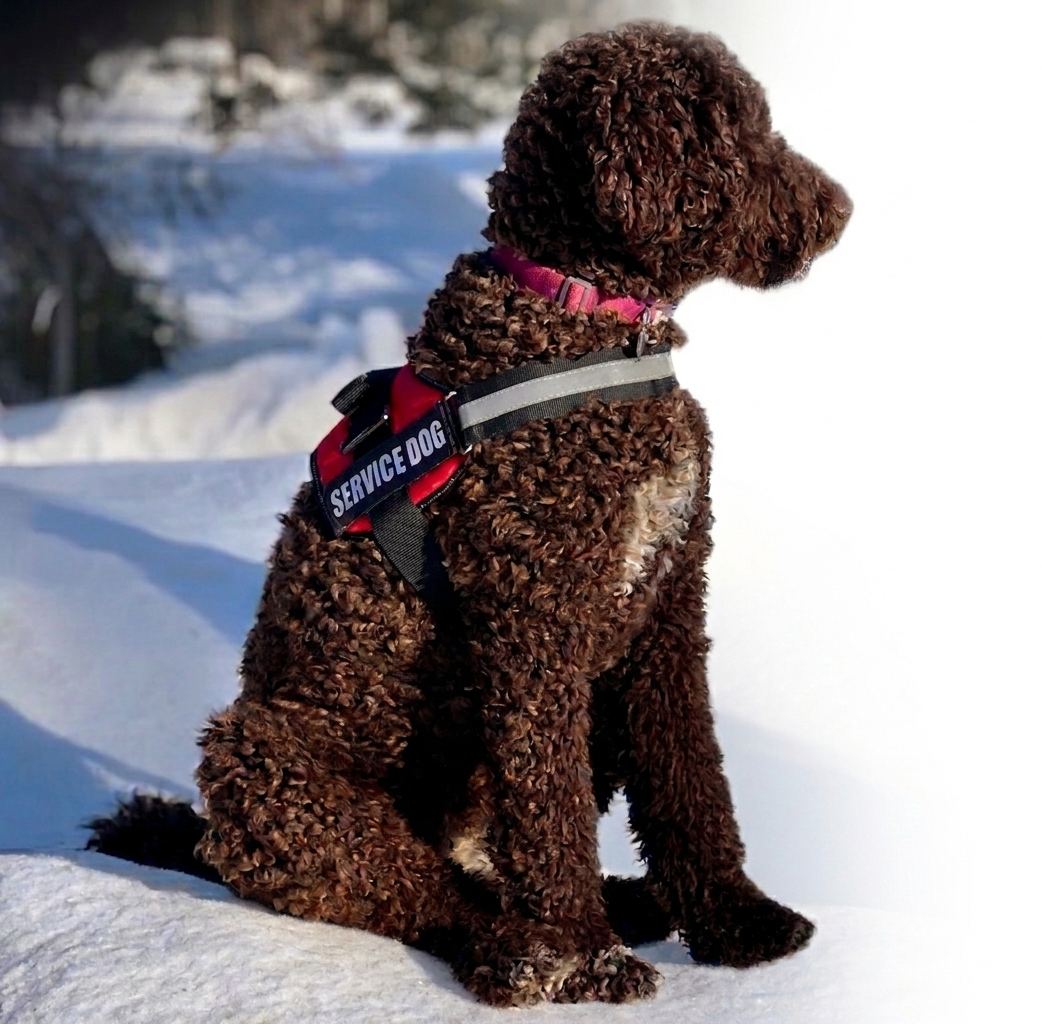
1. What is the difference between a service dog, a therapy dog, and an emotional support animal (ESA)?
- Service Dogs: Individually trained to perform specific tasks directly related to a handler’s disability. They have full public access rights under the ADA.
- Therapy Dogs: Trained to provide comfort, affection, and stress relief to other people in settings like hospitals, schools, and nursing homes. They do not have general public access.
- ESAs: Provide comfort to their handler through their presence alone. They lack task training and general public access rights.
2. Where are service dogs allowed to go?
Under the Americans with Disabilities Act (ADA), service dogs are permitted in all areas of public accommodations where the general public is normally allowed. This includes restaurants, grocery stores, hotels, medical facilities, retail stores, and public transit.
3. Do service dogs have to wear a vest, harness, or ID badge?
No. The ADA does not require service dogs to wear a vest, harness, special collar, or identification tag. Furthermore, official “service dog registration” or “certification” cards sold online carry no legal weight in the United States.
4. What questions can businesses legally ask a service dog handler?
When it is not obvious that a dog is a service animal, employees or business owners may legally ask only two questions:
- Is the dog a service animal required because of a disability?
- What work or task has the dog been trained to perform?
Businesses cannot ask about the individual’s disability, demand medical documentation, or require the dog to demonstrate the task.
5. What tasks can a service dog be trained to perform?
- Guide & Hearing: Navigating visually impaired handlers or alerting deaf handlers to sounds.
- Medical Alert: Sensing changes in blood sugar, oncoming seizures, or cardiac spikes.
- Mobility Assistance: Pulling wheelchairs, retrieving dropped items, or aiding balance.
- Psychiatric Tasks: Deep pressure therapy (DPT) for panic attacks, grounding during PTSD flashbacks, or creating space in crowds.
- And more.
- Yes and no. While we serve families and programs nationwide, we never ship our dogs in cargo. We believe in providing a safe, low-stress transition for every dog, offering three personal travel options:
- Personal Delivery: We hand-deliver your dog directly to you ourselves.
- In-Person Pickup: You are welcome to come meet us and pick up your dog in person.
- Flight Nanny Service: In special circumstances, a dedicated puppy nanny accompanies your dog in the cabin for the entire journey.
6. How do I apply, and how long is the waiting list
- Application Requirements: While most organizations begin with long written applications, we prefer to start with a personal conversation. We discreetly discuss your unique needs, daily challenges, and living arrangements, addressing any concerns you may have along the way. This allows us to truly understand your situation, evaluate the type of support you require, and match you with the specific dog that will be of the most help to you. To start the process please call Tanya at 208-304-3814
- Wait Times: We strive to keep fully trained dogs available so we can support those in need without delay. During our initial conversation, we’ll share our current availability to see if one of our dogs is the right match for you. If we don’t have an immediate fit, we will actively work with our trusted network of partners to find and source the exact dog suited to your needs.Many other companies have a 1 to 2 year wait time.
7. Can a service dog company train my existing pet?
- Unlike larger organizations with high-volume staff, we deliberately keep our focus personal and specialized. To ensure the highest level of care and quality, we exclusively train our own Doodles and those sourced from our trusted partners. By raising and training our dogs right from puppyhood, we lay a strong, consistent foundation for a lifetime of success and companionship.
8. What follow-up support or guarantees does the company offer after placement?
- You are never on this journey alone. When you welcome your dog into your home, we provide personalized, hands-on training to ensure you feel completely confident and comfortable handling them on your own. Even after your transition home, our support continues—you are always welcome to reach out to us with any questions or guidance you might need along the way.
9. What specific tasks do you train dogs to do?
- Our training program bridges solid home foundations with real-world exposure. We start with essential obedience—ensuring your dog masters sit, stay, come, lay down, and polite heel work both on and off-leash. We also establish reliable house manners, including home solitude and doggy-door potty training.
- From there, we advance to intensive public access training. Every single day, we bring our dogs into diverse public settings—from local restaurants and grocery stores to shopping malls, farmers markets, and bustling downtown areas. These daily outings build confidence and ensure their foundational training holds up wherever life takes you.
- See our Training page for more information.
10. How long does it take to get a service dog?
- Time: Immediate Placement: If we currently have an available dog that meets your specific needs, placement can happen immediately. See our available dogs.
- Custom Sourcing: If we don’t have an instant match on hand, we will search our trusted partners to find the perfect puppy. In those cases, the process typically takes between immediate to 6 months to source and raise your dog to working standards.
11. How much does a service dog cost?
- Cost: Fully trained program service dogs can range anywhere from $16,000 to $20,000+ depending on the complexity of the tasks required. We strive to keep training expenses down whereas other companies charge $40,000 plus for a service Dog. 
12. Is it illegal to fake a service dog?
Yes, in many jurisdictions. Placing a service dog vest or patch on a pet to bring them into non-pet-friendly public spaces is illegal in over 30 states. Misrepresenting a pet can result in fines, misdemeanor charges, and compromises the safety of legitimate working teams.
13. Do you ship service dogs nationwide?
14. What are the rules for interacting with a service dog vs. a therapy dog?
- Service Dogs: Always assume they are working. Do not pet, feed, talk to, call out to, or distract a working service dog team without express permission from the handler.
- Therapy Dogs: Interaction and petting are actively encouraged while the dog is on duty, provided the handler gives the okay.
15. Should service Dogs be crated?
- Yes, and no:
Deciding whether to crate train a service dog is ultimately a personal choice for every owner. At Sandpoint Doodles, our policy is not to crate train our service animals. We believe that with comprehensive behavioral training, a service dog should be fully trusted with free roam of the home, including the independence to venture outside and behave responsibly without requiring confinement.